AI & ML Models
0.0 (0 reviews) • 0 downloads
Audio Reconstructed in Python Projects
र 1000
Audio Reconstructed in Python Projects
Technical Details
Domain : Python
Database : Sqlite
Tools : Anaconda
Run Tools: VS Code
Database : Sqlite
Tools : Anaconda
Run Tools: VS Code
Secure Payment
Instant Download
GST Invoice
24/7 Support
About This Product
Audio Reconstructed in Python Projects
Abstract
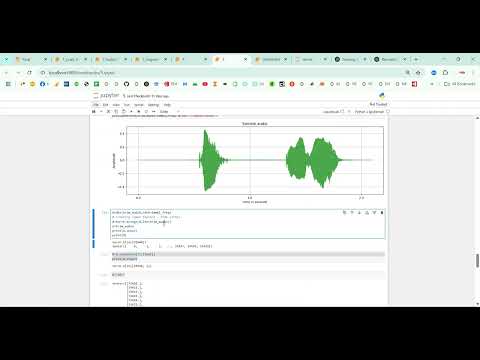
Audio reconstruction is an essential area in digital signal processing and machine learning that focuses on restoring or enhancing audio signals from incomplete, noisy, or degraded recordings. The project titled Audio Reconstructed in Python Projects aims to develop a system that can reconstruct high-quality audio from corrupted, low-bitrate, or partially missing recordings using AI techniques. Python is chosen as the development platform due to its rich ecosystem of libraries such as NumPy, SciPy, Librosa, TensorFlow, and PyTorch, which facilitate audio processing, feature extraction, and deep learning model implementation. The system uses signal processing methods combined with neural networks, including Autoencoders, Convolutional Neural Networks (CNN), and Recurrent Neural Networks (RNN), to predict missing audio segments and improve signal clarity. This project demonstrates how AI-driven audio reconstruction can enhance audio quality for music, speech, and communication systems while enabling real-time applications in various multimedia domains.
Existing System
The existing audio reconstruction systems primarily rely on classical signal processing techniques, such as Fourier transform-based filtering, interpolation, and noise reduction methods. These traditional approaches can improve audio clarity to some extent but are limited in handling complex audio distortions, long missing segments, or highly noisy recordings. Manual editing in digital audio workstations (DAWs) is time-consuming and requires expert knowledge, making it inefficient for large-scale or real-time audio restoration. Existing systems often struggle with preserving the natural timbre, pitch, and temporal continuity of the audio, resulting in synthetic or distorted reconstructions. Moreover, many current solutions do not leverage data-driven learning from large audio datasets, which limits their adaptability and accuracy when encountering diverse audio types and unforeseen distortions.
Proposed System
The proposed system introduces a Python-based AI framework for audio reconstruction that combines signal processing with deep learning techniques. Audio signals are first preprocessed using techniques like noise reduction, normalization, and feature extraction, including spectrograms or Mel-frequency cepstral coefficients (MFCCs). Autoencoder architectures are employed to learn compressed representations of clean audio and reconstruct missing or corrupted segments. Convolutional Neural Networks (CNN) can capture spatial patterns in spectrograms, while Recurrent Neural Networks (RNN) or LSTM models model temporal dependencies in sequential audio data. Python libraries such as Librosa handle audio input/output and feature extraction, while TensorFlow and PyTorch are used to implement and train the neural network models. The system also supports real-time audio streaming and reconstruction, allowing for applications in telecommunication, music restoration, and voice enhancement. Overall, the proposed system improves audio quality, restores lost segments, and provides an adaptive, data-driven approach to high-fidelity audio reconstruction.
Abstract
Audio reconstruction is an essential area in digital signal processing and machine learning that focuses on restoring or enhancing audio signals from incomplete, noisy, or degraded recordings. The project titled Audio Reconstructed in Python Projects aims to develop a system that can reconstruct high-quality audio from corrupted, low-bitrate, or partially missing recordings using AI techniques. Python is chosen as the development platform due to its rich ecosystem of libraries such as NumPy, SciPy, Librosa, TensorFlow, and PyTorch, which facilitate audio processing, feature extraction, and deep learning model implementation. The system uses signal processing methods combined with neural networks, including Autoencoders, Convolutional Neural Networks (CNN), and Recurrent Neural Networks (RNN), to predict missing audio segments and improve signal clarity. This project demonstrates how AI-driven audio reconstruction can enhance audio quality for music, speech, and communication systems while enabling real-time applications in various multimedia domains.
Existing System
The existing audio reconstruction systems primarily rely on classical signal processing techniques, such as Fourier transform-based filtering, interpolation, and noise reduction methods. These traditional approaches can improve audio clarity to some extent but are limited in handling complex audio distortions, long missing segments, or highly noisy recordings. Manual editing in digital audio workstations (DAWs) is time-consuming and requires expert knowledge, making it inefficient for large-scale or real-time audio restoration. Existing systems often struggle with preserving the natural timbre, pitch, and temporal continuity of the audio, resulting in synthetic or distorted reconstructions. Moreover, many current solutions do not leverage data-driven learning from large audio datasets, which limits their adaptability and accuracy when encountering diverse audio types and unforeseen distortions.
Proposed System
The proposed system introduces a Python-based AI framework for audio reconstruction that combines signal processing with deep learning techniques. Audio signals are first preprocessed using techniques like noise reduction, normalization, and feature extraction, including spectrograms or Mel-frequency cepstral coefficients (MFCCs). Autoencoder architectures are employed to learn compressed representations of clean audio and reconstruct missing or corrupted segments. Convolutional Neural Networks (CNN) can capture spatial patterns in spectrograms, while Recurrent Neural Networks (RNN) or LSTM models model temporal dependencies in sequential audio data. Python libraries such as Librosa handle audio input/output and feature extraction, while TensorFlow and PyTorch are used to implement and train the neural network models. The system also supports real-time audio streaming and reconstruction, allowing for applications in telecommunication, music restoration, and voice enhancement. Overall, the proposed system improves audio quality, restores lost segments, and provides an adaptive, data-driven approach to high-fidelity audio reconstruction.
Customer Reviews (0)
No reviews yet. Be the first!
Related Products
⭐ Featured

AI & ML Models
Zomato Restaurant Reviews Sentimental Analyzer in Python Projects
Zomato Restaurant Reviews Sentimental Analyzer in Python Projects
र 1000
⭐ Featured
⭐ Featured

AI & ML Models
Voice Disorder Prediction using Audio Dataset in Python Projects
Voice Disorder Prediction using Audio Dataset in Python Projects
र 1000

AI & ML Models
Vitamin Deficiency Detection Using Image Processing in Python Projects
Vitamin Deficiency Detection Using Image Processing in Python Projects
र 1000