AI & ML Models
0.0 (0 reviews) • 0 downloads
Apple Fruit Disease Detection Jupyter in Python Projects
र 1000
Apple Fruit Disease Detection Jupyter in Python Projects
Technical Details
Domain : Python
Database : Sqlite
Tools : Anaconda
Run Tools: VS Code
Database : Sqlite
Tools : Anaconda
Run Tools: VS Code
Secure Payment
Instant Download
GST Invoice
24/7 Support
About This Product
Apple Fruit Disease Detection Jupyter in Python Projects
Abstract
Apple crops are highly susceptible to various diseases, which can significantly reduce yield and affect fruit quality. Early detection of diseases is crucial for timely intervention and effective crop management. This project presents an Apple Fruit Disease Detection System using Python in Jupyter Notebook, which leverages image processing and machine learning techniques to classify apple fruits as healthy or affected by common diseases such as apple scab, black rot, or cedar apple rust. The system uses image datasets of apple leaves and fruits to train models such as Convolutional Neural Networks (CNNs) for accurate disease recognition. Python libraries including OpenCV, TensorFlow/Keras, Pandas, NumPy, and Matplotlib are used for image preprocessing, feature extraction, model training, and visualization. This solution helps farmers and agricultural specialists detect diseases early, reduce crop loss, and optimize disease management strategies.
Existing System
In the existing system, apple disease detection primarily relies on manual inspection by farmers or agricultural experts. This approach is time-consuming, subjective, and prone to errors, especially for large-scale orchards. Traditional techniques involve visual observation of leaves, fruits, and stems, but subtle symptoms may be missed, leading to delayed intervention. Some computerized systems exist using basic image processing and machine learning, but they often require extensive feature engineering and do not provide real-time analysis. Moreover, many current systems lack user-friendly interfaces, making them inaccessible to farmers with limited technical knowledge.
Proposed System
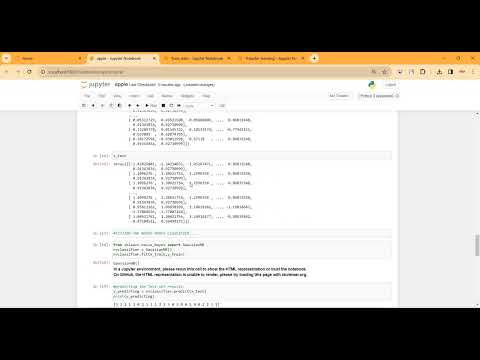
The proposed system introduces an automated apple fruit disease detection platform using Python and Jupyter Notebook. The system collects images of apple leaves and fruits from open-source datasets or farm-specific datasets. Image preprocessing techniques such as resizing, normalization, and augmentation are applied to improve model performance. Convolutional Neural Networks (CNNs) are trained to automatically extract features and classify fruits as healthy or infected with specific diseases. The model’s predictions are evaluated using metrics like accuracy, precision, recall, and F1-score. The entire workflow is implemented in Jupyter Notebook, providing an interactive environment for visualization, testing, and model refinement. Farmers and agricultural professionals can use the system to upload images and receive instant disease predictions, enabling early intervention and efficient crop management. This automated approach enhances accuracy, scalability, and accessibility compared to traditional manual inspection methods.
Abstract
Apple crops are highly susceptible to various diseases, which can significantly reduce yield and affect fruit quality. Early detection of diseases is crucial for timely intervention and effective crop management. This project presents an Apple Fruit Disease Detection System using Python in Jupyter Notebook, which leverages image processing and machine learning techniques to classify apple fruits as healthy or affected by common diseases such as apple scab, black rot, or cedar apple rust. The system uses image datasets of apple leaves and fruits to train models such as Convolutional Neural Networks (CNNs) for accurate disease recognition. Python libraries including OpenCV, TensorFlow/Keras, Pandas, NumPy, and Matplotlib are used for image preprocessing, feature extraction, model training, and visualization. This solution helps farmers and agricultural specialists detect diseases early, reduce crop loss, and optimize disease management strategies.
Existing System
In the existing system, apple disease detection primarily relies on manual inspection by farmers or agricultural experts. This approach is time-consuming, subjective, and prone to errors, especially for large-scale orchards. Traditional techniques involve visual observation of leaves, fruits, and stems, but subtle symptoms may be missed, leading to delayed intervention. Some computerized systems exist using basic image processing and machine learning, but they often require extensive feature engineering and do not provide real-time analysis. Moreover, many current systems lack user-friendly interfaces, making them inaccessible to farmers with limited technical knowledge.
Proposed System
The proposed system introduces an automated apple fruit disease detection platform using Python and Jupyter Notebook. The system collects images of apple leaves and fruits from open-source datasets or farm-specific datasets. Image preprocessing techniques such as resizing, normalization, and augmentation are applied to improve model performance. Convolutional Neural Networks (CNNs) are trained to automatically extract features and classify fruits as healthy or infected with specific diseases. The model’s predictions are evaluated using metrics like accuracy, precision, recall, and F1-score. The entire workflow is implemented in Jupyter Notebook, providing an interactive environment for visualization, testing, and model refinement. Farmers and agricultural professionals can use the system to upload images and receive instant disease predictions, enabling early intervention and efficient crop management. This automated approach enhances accuracy, scalability, and accessibility compared to traditional manual inspection methods.
Customer Reviews (0)
No reviews yet. Be the first!
Related Products
⭐ Featured

AI & ML Models
Zomato Restaurant Reviews Sentimental Analyzer in Python Projects
Zomato Restaurant Reviews Sentimental Analyzer in Python Projects
र 1000
⭐ Featured
⭐ Featured

AI & ML Models
Voice Disorder Prediction using Audio Dataset in Python Projects
Voice Disorder Prediction using Audio Dataset in Python Projects
र 1000
AI & ML Models
Vitamin Deficiency Detection Using Image Processing in Python Projects
Vitamin Deficiency Detection Using Image Processing in Python Projects
र 1000