Android Malware Federated Learning COLAB in Python Projects
र 1000
Android Malware Federated Learning COLAB in Python Projects
Technical Details
Domain : Python
Database : Sqlite
Tools : Anaconda
Run Tools: VS Code
Database : Sqlite
Tools : Anaconda
Run Tools: VS Code
Secure Payment
Instant Download
GST Invoice
24/7 Support
About This Product
Android Malware Federated Learning COLAB in Python Projects
Abstract
With the increasing number of Android devices and applications, malware detection has become a critical concern for mobile security. Traditional centralized machine learning models require aggregating sensitive APK data from multiple devices, raising privacy concerns. This project implements an Android Malware Detection system using Federated Learning in Python, deployed on Google Colab for ease of experimentation and model training. The system allows multiple devices or simulated clients to collaboratively train a global machine learning model without sharing raw data. Static features such as permissions, API calls, and manifest components are extracted from APK files and locally processed on each client. Python libraries such as TensorFlow Federated, Pandas, NumPy, and Scikit-learn are used to develop, train, and evaluate the model. Federated learning ensures privacy-preserving malware detection, improves model generalization, and enables secure collaborative training across multiple data sources.
Existing System
Existing Android malware detection systems rely mostly on centralized machine learning models or traditional signature-based antivirus solutions. Centralized ML models require collecting all APK data in one server for training, which exposes sensitive user information and raises privacy and legal concerns. Signature-based methods are ineffective against new or obfuscated malware, while centralized ML models struggle to handle distributed datasets from multiple devices. Moreover, conventional approaches do not leverage collaborative training across multiple clients and fail to address the challenge of privacy-preserving learning. Consequently, these systems cannot scale effectively for real-world distributed environments and are prone to privacy risks.
Proposed System
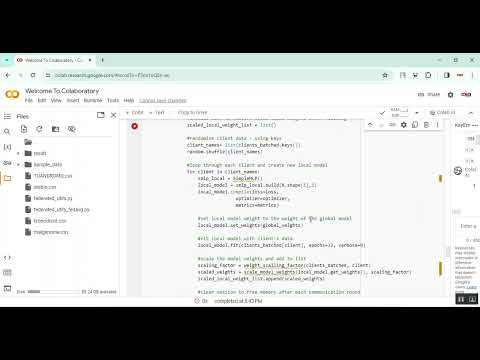
The proposed system introduces a Federated Learning-based Android Malware Detection framework implemented in Python and executed on Google Colab for flexible training. Each simulated client (or device) extracts features from APK files, such as permissions, API calls, and manifest attributes, and trains a local machine learning model (e.g., Random Forest, SVM, or neural network). The local model updates are then aggregated on a central server to form a global model without sharing raw data, preserving privacy. The system iteratively updates the global model while clients continue local training, improving accuracy and generalization. Federated learning ensures secure collaboration across multiple datasets and supports scalable deployment. Streamlit or Jupyter notebooks can be used to visualize training progress, detection accuracy, and feature importance. This system enables privacy-preserving, distributed, and intelligent Android malware detection suitable for modern mobile security environments.
Abstract
With the increasing number of Android devices and applications, malware detection has become a critical concern for mobile security. Traditional centralized machine learning models require aggregating sensitive APK data from multiple devices, raising privacy concerns. This project implements an Android Malware Detection system using Federated Learning in Python, deployed on Google Colab for ease of experimentation and model training. The system allows multiple devices or simulated clients to collaboratively train a global machine learning model without sharing raw data. Static features such as permissions, API calls, and manifest components are extracted from APK files and locally processed on each client. Python libraries such as TensorFlow Federated, Pandas, NumPy, and Scikit-learn are used to develop, train, and evaluate the model. Federated learning ensures privacy-preserving malware detection, improves model generalization, and enables secure collaborative training across multiple data sources.
Existing System
Existing Android malware detection systems rely mostly on centralized machine learning models or traditional signature-based antivirus solutions. Centralized ML models require collecting all APK data in one server for training, which exposes sensitive user information and raises privacy and legal concerns. Signature-based methods are ineffective against new or obfuscated malware, while centralized ML models struggle to handle distributed datasets from multiple devices. Moreover, conventional approaches do not leverage collaborative training across multiple clients and fail to address the challenge of privacy-preserving learning. Consequently, these systems cannot scale effectively for real-world distributed environments and are prone to privacy risks.
Proposed System
The proposed system introduces a Federated Learning-based Android Malware Detection framework implemented in Python and executed on Google Colab for flexible training. Each simulated client (or device) extracts features from APK files, such as permissions, API calls, and manifest attributes, and trains a local machine learning model (e.g., Random Forest, SVM, or neural network). The local model updates are then aggregated on a central server to form a global model without sharing raw data, preserving privacy. The system iteratively updates the global model while clients continue local training, improving accuracy and generalization. Federated learning ensures secure collaboration across multiple datasets and supports scalable deployment. Streamlit or Jupyter notebooks can be used to visualize training progress, detection accuracy, and feature importance. This system enables privacy-preserving, distributed, and intelligent Android malware detection suitable for modern mobile security environments.
Customer Reviews (0)
No reviews yet. Be the first!