AI & ML Models
0.0 (0 reviews) • 0 downloads
Alzheimers Classification in Python Projects
र 1000
Alzheimers Classification in Python Projects
Technical Details
Domain : Python
Database : Sqlite
Tools : Anaconda
Run Tools: VS Code
Database : Sqlite
Tools : Anaconda
Run Tools: VS Code
Secure Payment
Instant Download
GST Invoice
24/7 Support
About This Product
Alzheimers Classification in Python Projects
Abstract
Alzheimer’s disease is a chronic neurodegenerative disorder that leads to gradual cognitive decline, memory loss, and impaired reasoning, primarily affecting older adults. Timely and accurate classification of Alzheimer’s disease stages is essential for early treatment planning and slowing disease progression. This project titled Alzheimer’s Classification in Python Projects focuses on the development of an intelligent machine learning and deep learning-based system that classifies Alzheimer’s disease into different stages such as Mild Cognitive Impairment (MCI), Early Stage Alzheimer’s, Moderate Alzheimer’s, and Severe Alzheimer’s. Python is used as the development platform due to its extensive data science and image processing libraries such as TensorFlow, Scikit-learn, Keras, OpenCV, and NumPy. The system processes MRI brain scan images or clinical data to categorize patients based on disease stage. This AI-assisted diagnostic system offers a fast, cost-effective, and automated approach to support neurologists and radiologists in medical decision-making.
Existing System
The existing system for diagnosing Alzheimer’s disease is primarily based on manual neurological assessments, neuropsychological tests, and patient history evaluations. Medical imaging such as MRI and PET scans are used, but their interpretation depends greatly on specialist expertise, which often leads to delays and possible misclassifications. Early symptoms of Alzheimer’s are similar to normal aging memory loss, making detection difficult during the initial stages. Moreover, traditional diagnosis methods do not provide automated classification of disease severity levels and lack computational support for data analysis. Human-dependent diagnosis increases the possibility of subjective errors and variability in results. Existing systems also lack large-scale screening capabilities due to limited resources and manual intervention requirements. Overall, traditional approaches are time-consuming, expensive, and lack precision in distinguishing between different stages of Alzheimer’s disease.
Proposed System
The proposed system introduces an AI-powered Alzheimer’s disease classification framework using Python to automatically categorize patients based on MRI brain image analysis or clinical diagnostic datasets. The system uses preprocessing techniques to enhance image quality, extract critical brain features, and reduce noise. Deep learning models such as Convolutional Neural Networks (CNN), VGGNet, ResNet, and MobileNet are used for feature extraction and classification. Machine learning algorithms like Random Forest and Support Vector Machine (SVM) can also be applied for clinical data classification. The model is trained on labeled datasets containing Alzheimer’s images from public repositories like Kaggle or ADNI. The system provides accurate disease classification along with confidence scores and visual heatmaps indicating affected regions. A user-friendly interface is developed using Flask or Tkinter for easy access by medical professionals. The system enhances diagnostic accuracy, supports early intervention, reduces dependency on specialists, and enables intelligent healthcare automation.
Abstract
Alzheimer’s disease is a chronic neurodegenerative disorder that leads to gradual cognitive decline, memory loss, and impaired reasoning, primarily affecting older adults. Timely and accurate classification of Alzheimer’s disease stages is essential for early treatment planning and slowing disease progression. This project titled Alzheimer’s Classification in Python Projects focuses on the development of an intelligent machine learning and deep learning-based system that classifies Alzheimer’s disease into different stages such as Mild Cognitive Impairment (MCI), Early Stage Alzheimer’s, Moderate Alzheimer’s, and Severe Alzheimer’s. Python is used as the development platform due to its extensive data science and image processing libraries such as TensorFlow, Scikit-learn, Keras, OpenCV, and NumPy. The system processes MRI brain scan images or clinical data to categorize patients based on disease stage. This AI-assisted diagnostic system offers a fast, cost-effective, and automated approach to support neurologists and radiologists in medical decision-making.
Existing System
The existing system for diagnosing Alzheimer’s disease is primarily based on manual neurological assessments, neuropsychological tests, and patient history evaluations. Medical imaging such as MRI and PET scans are used, but their interpretation depends greatly on specialist expertise, which often leads to delays and possible misclassifications. Early symptoms of Alzheimer’s are similar to normal aging memory loss, making detection difficult during the initial stages. Moreover, traditional diagnosis methods do not provide automated classification of disease severity levels and lack computational support for data analysis. Human-dependent diagnosis increases the possibility of subjective errors and variability in results. Existing systems also lack large-scale screening capabilities due to limited resources and manual intervention requirements. Overall, traditional approaches are time-consuming, expensive, and lack precision in distinguishing between different stages of Alzheimer’s disease.
Proposed System
The proposed system introduces an AI-powered Alzheimer’s disease classification framework using Python to automatically categorize patients based on MRI brain image analysis or clinical diagnostic datasets. The system uses preprocessing techniques to enhance image quality, extract critical brain features, and reduce noise. Deep learning models such as Convolutional Neural Networks (CNN), VGGNet, ResNet, and MobileNet are used for feature extraction and classification. Machine learning algorithms like Random Forest and Support Vector Machine (SVM) can also be applied for clinical data classification. The model is trained on labeled datasets containing Alzheimer’s images from public repositories like Kaggle or ADNI. The system provides accurate disease classification along with confidence scores and visual heatmaps indicating affected regions. A user-friendly interface is developed using Flask or Tkinter for easy access by medical professionals. The system enhances diagnostic accuracy, supports early intervention, reduces dependency on specialists, and enables intelligent healthcare automation.
Customer Reviews (0)
No reviews yet. Be the first!
Related Products
⭐ Featured

AI & ML Models
Zomato Restaurant Reviews Sentimental Analyzer in Python Projects
Zomato Restaurant Reviews Sentimental Analyzer in Python Projects
र 1000
⭐ Featured
⭐ Featured

AI & ML Models
Voice Disorder Prediction using Audio Dataset in Python Projects
Voice Disorder Prediction using Audio Dataset in Python Projects
र 1000
AI & ML Models
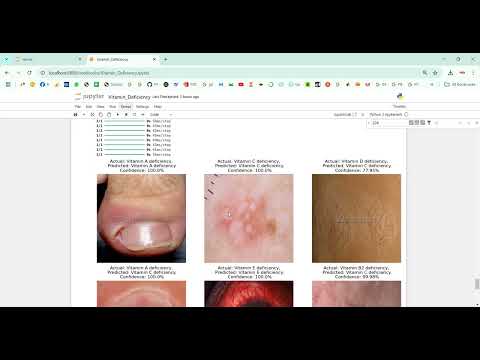
Vitamin Deficiency Detection Using Image Processing in Python Projects
Vitamin Deficiency Detection Using Image Processing in Python Projects
र 1000